
Imagine it’s Monday morning, a big economic print is due, and you want to shift a position from spot into perpetuals on OKX. You open your browser, type the exchange address, and pause: did you log out on your phone? Is your 2FA working? Do you use the centralized account or your non-custodial Web3 wallet? That pause is not trivial — the way you authenticate and choose custody on OKX changes both the mechanics of what you can do in seconds and the kinds of risk you carry for the rest of the week.
This explainer walks through the mechanisms behind OKX sign in (the centralized account flow), OKX login for the Web3 wallet, and how the two custody models interact. I’ll show what happens under the hood when you authenticate, compare trade-offs for US-based traders, flag common failure modes, and offer actionable heuristics you can use before you hit “Confirm” on a trade or withdrawal.
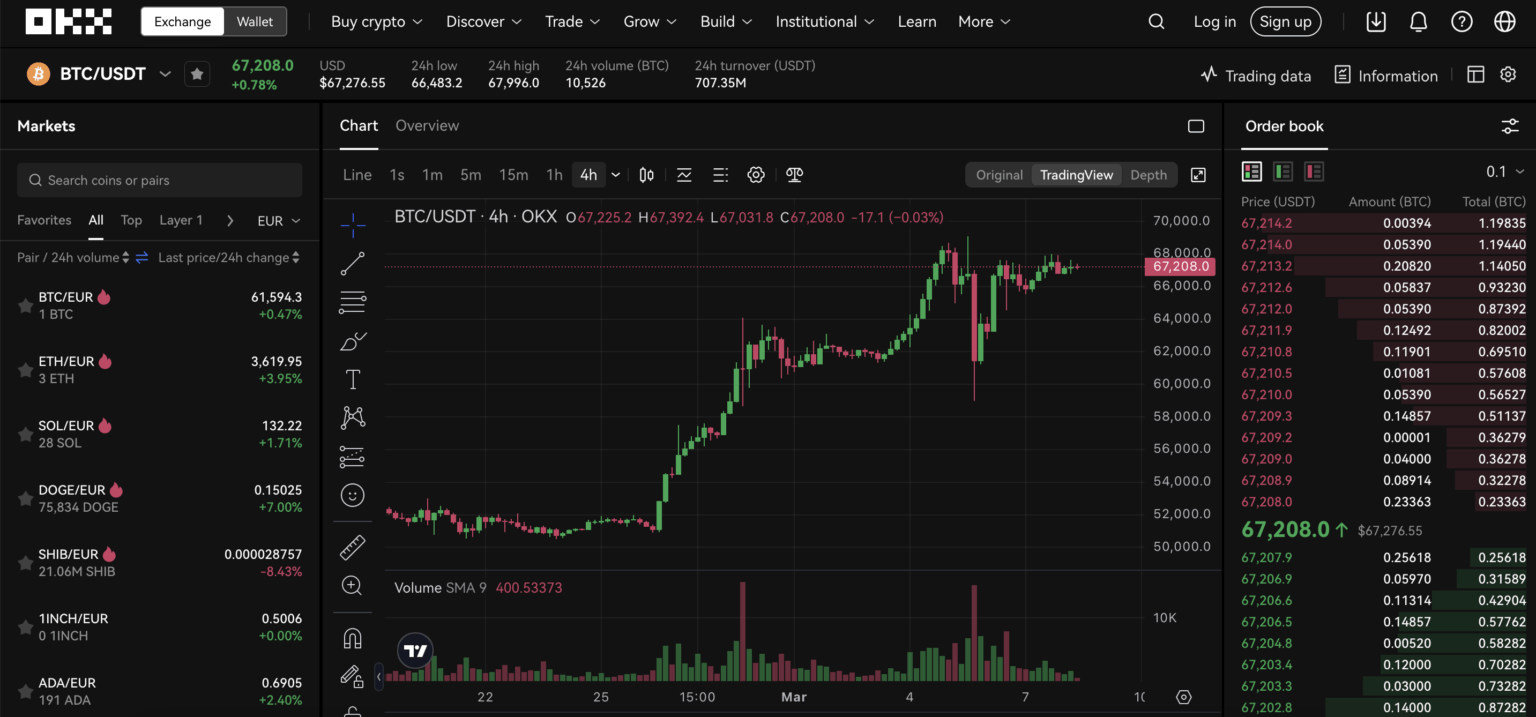
What “OKX Sign In” Really Does: authentication, session, and privileges
At first glance, signing in is just entering an email and password. Mechanically, a successful OKX sign in does three things: 1) it verifies credentials against OKX’s identity database (which is tied to your KYC record in the US); 2) it establishes an encrypted session token that your browser or app uses for subsequent API calls; and 3) it associates a set of privileges to that session (spot trading, margin, staking, withdrawals) based on account level and KYC status.
Two practical consequences follow. One: your session token is the key to automated actions from the app. If your device is compromised, an attacker with a valid session token can attempt trades or withdrawals until 2FA or hot-path risk controls intervene. Two: some capabilities — for example, margin trading or withdrawals above certain thresholds — are gated by KYC and internal risk flags, not just password knowledge. That is why KYC and liveness checks matter in the US: they are a regulatory gate as well as a security one.
OKX Login Options: 2FA, biometrics, and the Web3 wallet
OKX requires mandatory Two-Factor Authentication (2FA). Mechanically, after you enter credentials, the server challenges you for a second proof: one-time codes (Google Authenticator), SMS, or biometric tokens via the mobile app. Biometric login on iOS/Android short-circuits typing but still ties back to the session token issued by OKX; biometrics unlock the device-stored credentials rather than replacing server-side authentication.
Parallel to the centralized account is OKX’s non-custodial Web3 wallet. “Login” here means different things: you don’t unlock a server-side account so much as decrypt a local private key (via a seed phrase, hardware wallet, or extension). That wallet can be connected to the OKX platform for DApps, swaps via the DEX aggregator, or NFT minting. The key conceptual difference is custody: with the Web3 wallet you hold private keys (and the usual single-point-of-failure — seed phrase loss); with the centralized account OKX holds custody but offers features like cold storage and Proof of Reserves transparency.
How custody choice changes your options and risks
If you plan to use futures, margin, or rapid spot trading, the centralized OKX account is operationally simpler: deposits are reflected instantly under the exchange ledger, orders match against internal liquidity, and features like staking or auto-compounding are front-and-center. Mechanistically, centralized custody lets OKX execute internal bookkeeping moves without on-chain transactions — faster and cheaper during high-volatility moments.
Conversely, a non-custodial Web3 wallet gives you true ownership of tokens, supports hardware wallets (Ledger, Trezor), and is essential if you want to interact with some DeFi protocols and DApps directly. The trade-off is obvious: you bear seed-phrase risk and smart contract exposure when you yield-farm or bridge tokens. For US traders who care about compliance, remember that moving assets off-exchange does not erase past records — tax and reporting considerations still apply.
Security architecture: cold storage, PoR, and endpoint threats
OKX’s architecture aims to blend the benefits of custody and transparency. Over 95% of assets are reportedly kept in air-gapped cold wallets that require multi-signature approvals for withdrawals — a structural defense against large-scale hacks. On top of that, OKX publishes Proof of Reserves so users can independently verify a 1:1 backing of deposited assets. Mechanistically, PoR gives public cryptographic signals about liquidity and solvency, but it is not a substitute for decentralized custody: PoR shows asset presence at a moment in time, not ongoing control or counterparty risk.
The most common attack path remains social engineering and endpoint compromise. Phishing pages that mimic OKX’s login flow can capture credentials and 2FA codes. Hardware wallet integration reduces that risk for the Web3 flow because a signed transaction requires a physical approval. But remember: hardware wallets protect private keys, not the account-level KYC flags or the exchange-side session that controls your exchange ledger entries.
Common failure modes and a short checklist to avoid them
Three failure modes matter in practice: lost seed phrase for a Web3 wallet (irrecoverable assets), compromised device with an active exchange session (unauthorized trades), and KYC friction (unable to withdraw or access features). For US traders the last one is not hypothetical — regulatory compliance can delay access if documents don’t pass automated checks.
Heuristic checklist before trading or withdrawing:
- Confirm device integrity: run an anti-malware scan and use a known browser or app.
- Prefer hardware wallet when moving significant on-chain amounts; use the non-custodial wallet for DeFi interactions requiring signatures.
- Keep 2FA on an authenticator app, not SMS, for lower SIM-swap risk.
- Test a small withdrawal first when interacting with a new chain or bridge via the DEX aggregator.
- Maintain secondary recovery (securely stored seed phrase) and update KYC docs ahead of large movements to avoid delays.
Where the login system can break and what to watch next
Operationally, login systems are resilient but not infallible. Service-wide outages, credential stuffing attacks, or surges in withdrawal requests (for example, after delistings or market shocks) can trigger rate-limits or temporary withdrawal freezes. A recent example of platform housekeeping — OKX delisting certain spot pairs this month — is routine but illustrates how liquidity and tradability change independently of your account access. If a token you use as margin is delisted, you might need to move positions quickly; that’s a place where login friction matters.
Signals to monitor: changes to 2FA options, announcements about withdrawal policies, and any updates to PoR methodology. If OKX expands hardware wallet integrations or tightens liveness checks, those changes will alter the convenience-security trade-off and might warrant an operational plan for migrating positions or adjusting how you authenticate.
Decision-useful takeaways for US traders
First, map actions to custody: use the centralized OKX account for high-frequency trading, margin, and staking, and use the non-custodial wallet when interacting with DeFi or holding assets long-term you want absolute control over. Second, treat login as the first line of defense — secure devices, prefer authenticator apps, and consider biometrics only as a convenience unlocked by a secure device. Third, run a routine: small test transfers, up-to-date KYC, and a hardware-wallet strategy for large on-chain moves.
Finally, when you need a quick, authoritative walkthrough of OKX’s web login flow and wallet options, the exchange’s help pages are useful; for a concise guide focused on the login web flow specifically, see this page: https://sites.google.com/cryptowalletextensionus.com/okx-login-web/.
FAQ
Q: If I lose my Web3 wallet seed phrase, can OKX restore my funds?
A: No. If assets are only in a self-custodial wallet tied to a seed phrase, OKX cannot restore private keys. That is the fundamental trade-off of non-custodial custody: total control if you secure the seed, permanent loss if you don’t. For assets held on OKX’s centralized ledger, the exchange can assist with account recovery under KYC rules.
Q: Which 2FA method should I use?
A: Authenticator apps (Google Authenticator, Authy) are generally safer than SMS because they avoid SIM-swap attacks. Biometric login is convenient but device-dependent; use it with a secure lock screen and only on trusted hardware. For the highest security, combine an authenticator app with hardware-wallet approvals for on-chain operations.
Q: Does Proof of Reserves mean OKX cannot go insolvent?
A: Proof of Reserves provides a cryptographic snapshot showing that assets exist on-chain and match liabilities at a point in time. It increases transparency but does not guarantee perpetual solvency or cover off-ledger risks. PoR is one signal among many — monitoring liquidity, regulatory developments, and operational controls remains important.
Q: Should I keep funds on OKX or in my Web3 wallet?
A: There is no universal answer. Keep funds you actively trade or want to stake on the exchange for convenience and access to yield products. Move long-term holdings or assets you intend to use in DeFi into a self-custodial wallet, ideally secured with a hardware device. The heuristic: custody aligns with intended use and acceptable risk.